

How to Put On a Duvet Cover Easily: 2 Simple and Quick Methods
How to Put On a Duvet Cover Easily: 2 Simple and Quick Methods
Many people find changing a duvet cover troublesome, not because the duvet cover itself is difficult, but because the duvet insert is bulky and prone to shifting, especially when you are doing it alone. In fact, once you master the right method, putting on a duvet cover can be much easier. The two most common methods are the traditional flip method and the Burrito Method. The burrito method is especially suitable for those who want to finish changing the duvet cover quickly by themselves.

I. What Is a Duvet Cover?
A duvet cover is a removable fabric casing that goes over a duvet insert. The duvet insert provides the main loft and warmth, while the duvet cover serves as the outer layer. In the international market and cross-border bedding procurement, duvet covers are usually sold as single pieces or sets with pillowcases (Duvet Cover Set / Duvet Cover Sets, Bed Quilt Cover / Bedding Quilt Cover).
Different countries and brands have regional naming habits for duvet covers: In North America and general global markets, they are often called Duvet Cover or Comforter Cover; In the UK, Europe and Australia, they are generally known as Quilt Cover / Quilt Covers; Australia and New Zealand also use the local term Doona Cover.
Definitions of duvet, duvet insert and comforter may vary between brands. Therefore, it is best to refer to the product descriptions on the listing when purchasing. Naturepedic notes that duvet and duvet insert are sometimes used interchangeably in daily use, but structurally, they can be simply understood as two parts: filling layer + outer cover.
The biggest feature of a duvet cover is that it can be detached. Unlike a finished comforter that must be washed as a whole, the duvet cover can be removed and washed separately for cleaning, featuring easy maintenance (Machine Washable / Easy Care / Fadeless). The Sleep Foundation lists the removable and separately washable outer casing as an important feature of duvet cover structures.
For consumers, you do not have to pursue complex structures when choosing a duvet cover. Details that truly affect user experience are usually whether the size matches, whether the four corners can be fixed easily (e.g. equipped with With 4 Corner Ties), whether the opening is convenient to operate, and the closure type (With Zipper Closure or Button Closure Duvet Cover) that suits your habits. For bedding buyers, these structural details are also key product design points to pay attention to.

II. Why Use a Duvet Cover?
The most direct purpose of using a duvet cover is to add a removable protective layer between the duvet insert and the outside environment. During sleep, bedding continuously contacts human skin flakes and bedroom dust. The removable outer layer makes cleaning and replacement much easier. The Sleep Foundation cites the removable, separately washable outer casing as a core advantage of duvet covers. Especially for sensitive groups, duvet covers with anti-dust-mite and anti-allergy properties (Anti Dust Mite Duvet Cover) can effectively block dust and allergens. For down duvets, high-density feather proof duvet shells or ticking covers (Feather Proof / Goose Down Proof Comforter Ticks) can effectively stop down leakage and protect the expensive duvet insert.
The second benefit is flexible styling for your bed. Since the duvet cover is the visible outermost layer of the bed, changing the duvet cover lets you change the color, pattern or overall style of the bedding without replacing the inner duvet insert. Whether you pick cooling breathable styles for summer (Cooling Duvet Cover / All Season Duvet Cover) or thick fabrics for warmth in autumn and winter, Naturepedic states that the duvet cover is an outer component independent of the filling, so you can swap it according to seasons and aesthetic preferences.
The third advantage is flexible matching. Consumers can select different duvet inserts and pair them with duvet covers of matching sizes. It should be noted that a duvet cover and duvet insert are not guaranteed to fit just because they share the same size name. Actual dimensions vary by brand and product, so check the exact measurements instead of only relying on Twin, Queen, King and other size labels. Relevant bedding guides recommend comparing the specific product dimensions.
For hotels, homestays, retailers and bedding wholesalers, this removable structure also brings flexibility in product portfolio. For example, the same type of duvet insert can be matched with duvet covers in different colours and fabrics to form multiple product bundles. However, the specific commercial benefits depend on product positioning, cost, washing requirements and sales channels, and the same duvet cover design is not suitable for all scenarios.
III. How to Put on a Duvet Cover: Two Simple Methods
If you are putting on a duvet cover for the first time, the key is not to use force, but to align the duvet cover and duvet insert properly. Many people struggle because they try to stuff the whole duvet insert into the cover at once, which causes the insert to shift and makes the four corners hard to locate.
Below are two common methods: the traditional method and the burrito method. The Sleep Foundation introduces both the Standard Method and Burrito Method, and both can be done by one person.
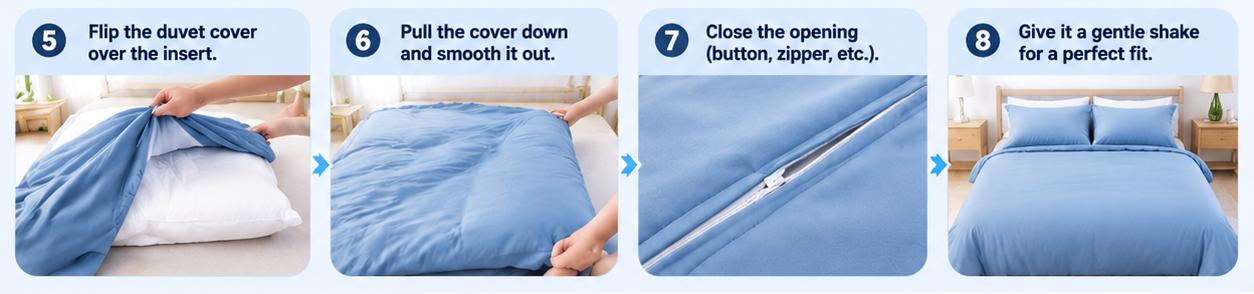
Traditional Method
- Lay the duvet insert flat on the bed and spread out its four corners naturally.
- Flip the duvet cover inside out and place the opening towards the foot of the bed.
- Lay the duvet insert on top of the duvet cover, aligning the four corners of the insert with the four corners of the cover as closely as possible.
- If the duvet cover has internal corner ties (With 4 Corner Ties) or anchor points, fasten the four corners of the duvet insert securely at this stage.
- Start from the head end of the bed and flip the duvet cover outward to wrap around the duvet insert gradually.
- Keep adjusting downward until the duvet insert is fully inside the cover.
- Check that all four corners are fully seated, then close the opening with the zipper (With Zipper Closure) or buttons (Button Closure).
- Shake and adjust gently to distribute the duvet insert evenly.
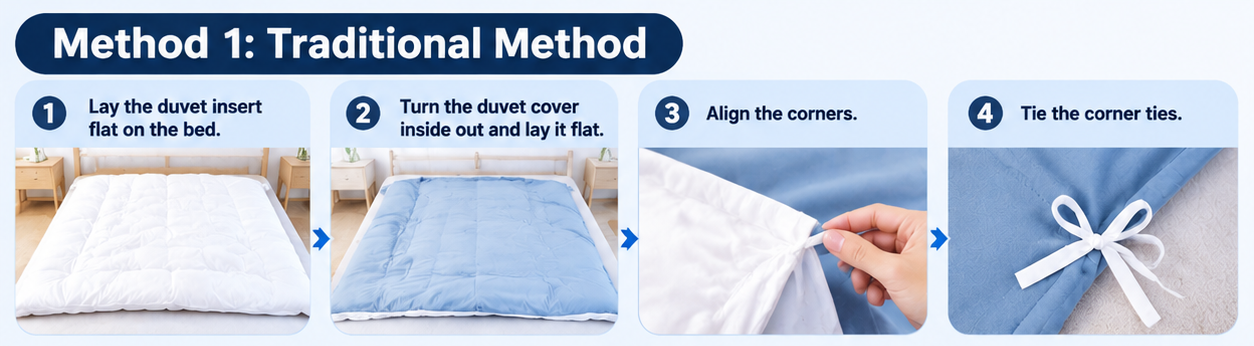
This method is intuitive and easy to understand for first-time users. Its downside is that for large duvet inserts, solo operation requires constant repositioning and adjustment, and extra-large bedding can feel cumbersome. If you often change large duvet covers alone, you may try the burrito method below.
Burrito Method
The principle of the burrito method is simple: roll the duvet cover and duvet insert together first, then wrap the whole roll through the cover opening and unroll it. It is called the Burrito Method because the whole process rolls the bedding into a shape like a burrito. The Sleep Foundation, HGTV and Crate & Barrel all share similar roll, flip and unroll workflows.
- Turn the duvet cover completely inside out with its inner side facing out, and lay it flat on the bed.
- Position the opening of the duvet cover toward the foot of the bed. Lay the duvet insert flat on top of the duvet cover, aligning the four corners and main edges.
- If there are internal 4 corner ties or fixing loops, secure the four corners of the duvet insert at this time.
- Starting from the head of the bed, tightly roll the duvet cover and duvet insert together toward the foot of the bed.
- After rolling to the foot of the bed, locate the opening of the duvet cover. Flip the duvet cover outward from the opening to gradually wrap the entire rolled duvet insert roll.
- Flip both sides and the middle section into place. Close the zipper (With Zipper Closure), buttons (Button Closure) or other closure structures.
- Unroll the whole bedding gently toward the head of the bed. Finally, shake and arrange the four corners lightly so that the duvet insert spreads evenly.
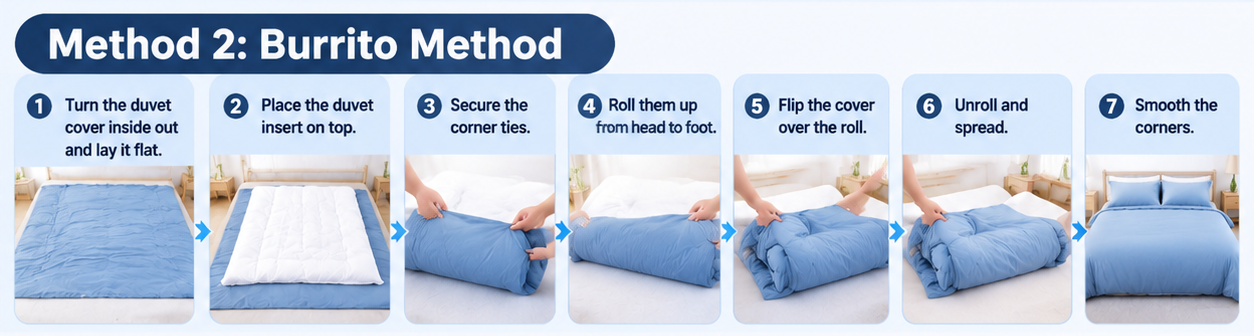
Avoid misaligning the duvet insert and cover while rolling. Align the four corners before starting, and fasten the corner ties (With 4 Corner Ties) if equipped, to keep everything aligned easily. Guides from Crate & Barrel and the Sleep Foundation also stress corner alignment and securing the duvet insert at appropriate stages.
IV. What Is the Difference Between the Traditional Method and the Burrito Method?
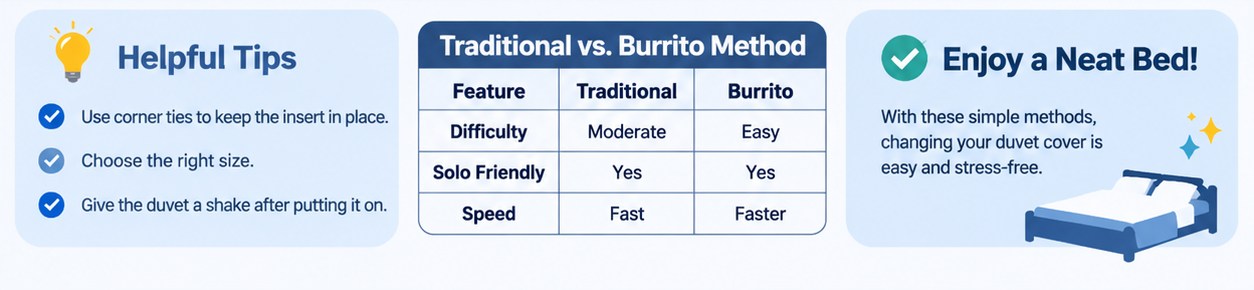
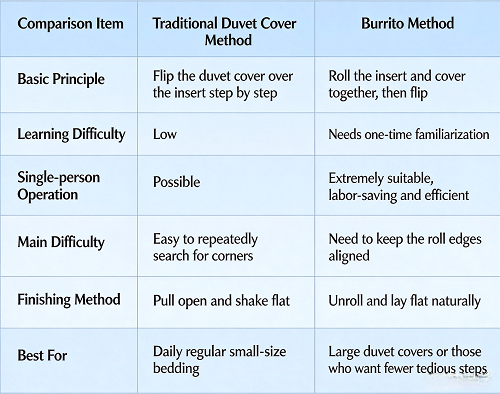
Both methods aim to get the duvet insert inside the cover with aligned corners, only the operating sequence differs. The traditional method follows our intuitive logic of “stuffing the insert into the cover”, while the burrito method rolls the two layers together first and finishes assembly by flipping.
In practical operation, the traditional method is easy to learn and does not require memorising special steps. It works well for small duvet inserts or users familiar with this routine. The Sleep Foundation lists this as the Standard Method and confirms it can be completed by one person.
The burrito method focuses on “align first, roll together, flip last”. It reduces the need to reach repeatedly inside the duvet cover to find corners, making it very attractive for solo users. Tutorials from HGTV and Crate & Barrel adopt this roll-and-flip logic.
Note that no single method works equally easily for all sizes and duvet cover constructions. The actual duvet cover size, opening size, internal fixing structure and duvet insert dimensions all affect operation experience. If one method feels very difficult, first check whether the bedding matches instead of assuming you are doing it wrong.
V. How to Stop the Duvet Insert From Shifting Inside the Cover?
If your duvet insert keeps sliding to one side after fitting, first check whether the sizes match. The Sleep Foundation explicitly recommends that duvet inserts and duvet covers should ideally have identical dimensions; a noticeably undersized or oversized insert will shift more easily.
Second, check the internal fixing structures. Many premium duvet covers have dedicated corner ties (With 4 Corner Ties), loops or anchor points at four corners, and the duvet insert may have matching anchor loops. Secure these points tightly to lock the four corners of the insert and stop shifting completely. The Sleep Foundation’s product guide notes that duvet covers and inserts can be connected via buttons, ties, loops or snaps.
Third, confirm whether the four corners are fully seated after fitting. If one corner of the duvet insert remains tucked toward the center, the bedding will be lopsided even after closing the opening. Therefore, check all four corners and smooth the bedding from the centre outwards after finishing.
For bedding product design, internal anchor points are a highly practical detail. For consumers, they reduce frequent rearranging. For hotels, wholesalers and retailers, they can serve as a high-quality specification for product comparison. The exact number, position and connection style of fixing points vary by product design, and buyers should refer to actual product specifications and samples.
VI. What to Look for When Choosing a Duvet Cover?
You should not only focus on colour and pattern when selecting a duvet cover. Factors that truly affect daily use and sleep experience usually include size specifications, closure types, internal fixing design, fabric materials and decorative craftsmanship.
- Size Specifications & Set Configurations The duvet cover must precisely match the duvet insert dimensions. Do not rely only on Queen, King and other general labels, as sizing standards differ by region and brand. When purchasing or bulk sourcing, verify the labelled length and width directly, and select single-piece options (e.g. 1pc Duvet Cover) or classic sets with pillowcases (Duvet Cover Set / Pintuck Queen Duvet Cover Set) as required.
- Opening & Closure Types Common designs include hidden zippers, buttons, snap fasteners and fabric ties: With Zipper Closure: Tight seal, quick operation, prevents the insert from slipping out, ideal for users prioritising fast changing and washing; Button Closure Duvet Cover: Vintage and elegant appearance, resistant to high-temperature washing, widely used in high-end hotels and classic bedding lines; Corner Fixing Details (With 4 Corner Ties): Whether zipper or button closure, duvet covers with internal corner ties are critical to keep the insert neatly in place.
- Fabric Materials & Seasonal Suitability Different fibers and weaves directly determine hand feel, breathability and temperature regulation: Natural Cotton & Plant Fibers: Bamboo Fiber Duvet Cover: Naturally silky, breathable, with cooling temperature regulation and antibacterial properties, a popular summer cooling option (Cooling Duvet Cover); 100% Linen Duvet Cover / Cotton Linen Duvet Cover: Excellent moisture wicking and breathability, unique textured look, suitable for all seasons; 100% Mulberry Silk Duvet Cover: 100% mulberry silk, skin-friendly and moisturising, luxurious touch for premium sleep; Waffle Cotton Duvet Cover: Three-dimensional honeycomb texture, moisture-absorbent and breathable with layered aesthetics; Silver Fiber Duvet Cover: Integrated technical silver fiber, focused on earthing conduction, antibacterial and odour-control for wellness sleep. Cost-Effective Synthetic & Printed Lines: Microfiber Duvet Cover: Brushed, soft and lightweight, high cost performance and durable for washing (Easy Care); 100% Polyester Printed Quilts Cover: Vibrant rich prints, colourfast (Fadeless). Autumn & Winter Warm Plush Series: Velvet Duvet Cover / Flannel Duvet Cover: Dense fine pile, locks heat well, suitable for cold weather; Plush Polyester Quilt Cover / Milk-down Quilt Cover: Cloud-like soft warm touch, strong wrapping warmth.
- Craftsmanship & Decor Styles Rich textures and decorative techniques make bedding a focal point in the bedroom: Tufted Duvet Cover / Tufting Rainbow Pattern: Three-dimensional tufting and rainbow geometric texture, warm retro bohemian style; Pinch Pleat Duvet Cover / Pintuck Queen Duvet Cover Set: Classic pinch and pintuck pleat three-dimensional craftsmanship, elegant layered look; Embroidered Duvet Cover / Elastic Embroidery: Delicate embroidery patterns and stretch embroidery, highlighting premium quality; Woven Duvet Cover: Fine textures woven from dyed yarns, stable texture and durable; Romantic Trims (Pom Duvet Cover Set / Ruffle Duvet Cover): Playful pom-pom trims or flowing ruffles to add romantic bedroom style; Patchwork Quilt Cover / Hand Block Printed: Traditional patchwork fabric art and hand block printing, unique artisanal charm.
VII. Frequently Asked Questions
- Can one person put on a duvet cover alone? Yes. Both the standard method and burrito method recommended by the Sleep Foundation can be done solo. For large duvet covers, lay the cover and insert flat on the bed first, use corner ties (With 4 Corner Ties) to position them before alignment and flipping, which is easier to control than operating in mid-air.
- What is the easiest way to put on a duvet cover? If you want to avoid repeatedly reaching into the cover to find corners, try the burrito method. Its core workflow is flip the cover inside out, align with the insert, roll together, flip the cover over the roll, then unroll and close the zipper (With Zipper Closure) or buttons.
- What is the Burrito Method? The Burrito Method is a technique to fit a duvet cover. It gets its name because you roll the duvet cover and insert together during the process. It is also known as the California Roll Method. Different tutorials have slight variations, but the core logic is always align — secure — roll — flip — unroll.
- Why does the duvet insert keep moving inside the cover? One common cause is mismatched sizes between insert and cover. Another key reason is unsecured corners or the absence of built-in corner ties (With 4 Corner Ties). First check the actual dimensions, then confirm whether the corner anchor points are fastened properly.
- Should I choose a duvet cover with With Zipper Closure or Button Closure Duvet Cover? Neither closure fits all products. Zipper closure is fast and tight for frequent washing; button closure is classic, beautiful and tolerant of high-temperature laundering. Make your choice based on usage frequency, washing habits, product positioning and production requirements.
- Must the duvet cover and duvet insert be exactly the same size? They should match, but matching size names alone does not guarantee fit. Actual dimensions vary between brands and products, so check the labelled length and width when purchasing or sourcing. Whether buying single duvet covers or bedding sets (Bed Quilt Cover / Bedding Quilt Cover), obvious size mismatch will increase shifting and wrinkling of the insert.
VIII. Conclusion
Putting on a duvet cover does not have to be tiring housework. Flip the cover inside out, align the four corners of the insert, and use built-in corner ties (With 4 Corner Ties) to hold position, and the whole process becomes smooth. The traditional method works for people familiar with regular routines, and the burrito method offers an alternative better suited for solo users.
For consumers, select duvet covers with matching sizes, convenient closures (With Zipper Closure or Button Closure Duvet Cover) and easy-care performance (Machine Washable / Easy Care / Fadeless) to reduce frequent rearranging.
For hotels, retailers, cross-border sellers and bedding buyers, besides basic appearance, you can develop product lines from multi-country naming terms (Duvet Cover / Quilt Cover / Comforter Cover / Doona Cover), natural or functional materials (Bamboo Fiber, 100% Linen, 100% Mulberry Silk, Silver Fiber), warmth and anti-allergy protection (Anti Dust Mite, Feather Proof / Goose Down Proof), and special craftsmanship (Tufted, Pinch Pleat, Embroidered, Pom, Patchwork), to precisely meet the sleep and sourcing demands of global buyers.